2006-03-12

Long before the Oscars were the BAFTA's--and they chose Brokeback Mountain!

BAFTA's , February 19, 2006
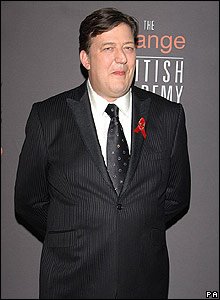
It was a night of surprises, an excellent, gracious and witty host - Stephen Fry who starred in Wilde (1997), as Oscar Wilde. It was also a night to thank George Clooney for stirring up the political volume in film. The highest honor went to producer Lord David Puttnam behind films like The Killing Fields, and Chariots of Fire,with Ben Cross sitting in the audience. Cross starred opposite Ian Charleson in Chariots of Fire (1981) - a film about "two men chasing dreams of glory" at the 1924 Olympics. Charleson died of AIDS in 1990. Putnam applauded the work of George Clooney for themes that had changed the industry in a year – probably the best accolade of the evening.

But above all it was a nite for Brokeback Mountain--best script, best adapted screenplay , best supporting actor.

"Its not a gay cowboy film", quipped the producer of Brokeback Mountain upon receiving the award for best film. "Its a gay shepard film!" Jake Gyllenhaal got his just rewards for best supporting actor. Jake reports in Premiere last month how hard it was to initiate 'the intimacy' in the film, but not when Ledger and he were wrestling. After all sports are perfectly acceptable homosocial encounters - for spectators and players alike. Observe the fascination for the Olympics. So, if 'love is a force of nature', as the film poster states, why not nominate both actors? The Brits did!

Fry's jokes went over well, many about the handsome men in the room and on stage. The awards ceremony was polished and intelligent. Tributes to people in the industry who had passed away was very well made -- with clips from films of among others, Shelley Winters, Sir John Miles and Richard Pryor.

Wallace and Gromit: the Curse of the Were Rabbit won best British film. The Constant Gardener, nominated for ten awards took home one award. The awards caused a stir the next day, how can we not reward our own? Not realizing that is exactly what Hollywood would do a couple of weeks later. Cheers to the Brits!

"I'm not a lesbian but my girlfriend is...."

Biopic on the late vocalist Dusty Springfield in the works, directed by Ang Lee. Charlize Theron will be cast as Springfield and opposite, as the PR goes, Springfield's lesbian lover Kate Moss. So what does that make Springfield? Remember that T-shirt "I'm not a lesbian but my girlfriend is". Here we go again. Marketing for an Ang Lee film about what it's not about....
Springfield biopic
Ang Lee's new film cast

Brokeback Tie-Ins?

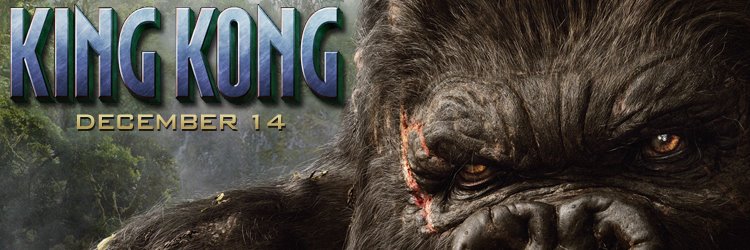
From the beginning Brokeback gained art house cult momentum from its Golden Lion at Venice to its opening in far less theaters than King Kong, but holding its own enough to surpass the Kong box office based on its exhibition availabilities. Now the film has moved into popular culture with auctions, music and advertising--that are not your usual 'tie-ins'.

This is an amazing phenomena to witness. I disagree that it has 'perked up' heterosexual interet in gay relationships. It reveals the extent of a covert homosexual culture forced underground for the prejudices and hate crimes depicted in 1960's middle America but are rampant everywhere today.
Pop Cult Brokeback
Quote:
"Brokeback" shirts go for more than $100k
The eBay auction of the two shirts worn by Heath Ledger and Jake Gyllenhall in "Brokeback Mountain" closed Sunday afternoon. The winning bid? $101,100.51!

The shirts were won by Tom Gregory, who placed the winning bid about 10 minutes before the auction closed. Gregory told PlanetOut he was thrilled that he won the auction, but explained his euphoria on a broader level. "The shirts represent such a significant moment in the history of film," Gregory said. "And when you see the shirts together in the closet in the film, it's an extraordinary moment for gay people. You just . . . sigh."

Brokeback auction

White Woman, King Kong

We all knew it was going to win something--visual. Thrilling dinosaur matches with King Kong, giant sucking insects, flying creatures which compel. Otherwise, why do a King Kong film now? The theme of the film, according to scriptwriter Jackson: "beauty destroyed the beast. The day she met him, he was a dead "man", captivated". Doesn't really explain why make a Kong film NOW, though.

A white woman esteemed by a gorilla. A white woman in a white dress walking through the streets of New York in 0 degree weather to find her King (Kong). A group of white men, (one) white woman , (one) Asian man and (one) black man on a boat to Skull Island? Spoilers: the black and Asian man die first. Next, a group of spirit possessed black islanders are subdued by the militarism of a ship's primarily white crew and captain? Why now? Why Kong?

I do not mean that the film is 'racist'. It skillfully uses race tropes, primarily white and black. By looking at how these tropes are used we can get a better sense of images are endowed in film , particularly images of 'white' people. Who gets contrasted against these seemingly 'normative' images? De-mythologizing, deconstructing "whiteness".

Kong also 'capitalizes' on macho gender roles. Ann does cartwheels to impress Kong, and all he can come back with is knocking her down over and over which gives him a real chuckle. When she challenges him, he feels emasculated, pounds his chest and fists and gets hit with a rock that falls on him from his rage attack. After that, she's gotten to him, and he's captive. Oh boy, how infantile can the scriptwriters get. Or casting - Jack Black could play Orson Welles, if he wasn't such a bad actor.

And have to agree that Kong gave Jackson the opportunity to work with the special effects of Lord of the Rings, and all that dinosaur flesh rolling over and over, with safty insects sucking up the men provide plenty of material.

Its impossible to ignore the racial tropes, its so obvious, and since Kong has been recycled many times, trotting out a new version exposes the story for these crystallized structures. What comes to mind when I watch this movie is film professor ( University of Warwick) Richard Dyer's masterful study White, on the representation of white in film, and the history of 'white' in culture. From Richard Dyer's White:

Quote:
White people are not literally or symbolically white; nor are they uniquely virtuous and pure. Racial imagery and racial representation are central to the organisation of the contemporary world but, while there are many studies of images of black and Asian people, whiteness is an invisible racial position. At the level of racial representation, whites are not of a certain race. They are just the human race, a 'colour' against which other ethnicities are always examined. In White , Richard Dyer looks beyond the apparent unremarkability of whiteness and argues for the importance of analysing images of white people. Dyer traces the representation of whiteness by whites in Western visual culture, focusing on the mass media of photography, advertising, fine art, cinema and television. Dyer examines the representation of whiteness and the white body in the contexts of Christianity, 'race' and colonialism and, in a series of absorbing case studies, he discusses the representations of whiteness in muscle-man action cinema, from Italian 'peplum' movies to the Tarzan and Rambo series; shows the construction of whiteness in photography and cinema in the lighting of white and black faces, and analyses the representation of white women in end-of-empire fictions such as The Jewel in the Crown , and traces the disturbing association of whiteness with death, in vampire narratives and dystopian films such as Blade Runner and the Aliens trilogy.


The part above about 'lighting' whiteness is especially true for Jackson's new film. Note how Watts is lit in the scenes where her whiteness is constrasted with the darkness of Skull Island, and islanders. And the scene where she finds Kong in NYC, wearing only a white gown. And in the end with Kong gone, its time to return to 'her own kind' with an embrace of Brody. No contrasts needed.

Regarding having new heights to the new tale, a modern Kong may have scaled the WTC, but in the original story, this was the Great Depression, and the Empire State Building was the tallest edifice to challenge Kong. Opening scenes of the film about time period promised something that just never was delivered. Jackson just got sucked into the story, its his kind of story anyway. He made it his kind of story.
Whose Cold Blood?

Its a pretty disturbing film when you realize that the character played by Phillip Seymour Hoffman is far from the vampire Truman Capote was in real life. Perry Smith confessed to the murders before he told Capote, unlike the version in the latest theatrical realize. Its doubtful that Truman assisted in stays of execution as the film intimates, but like the film used his money and influence to play with the courts and penal institutions to his whim and fancy. Amazing that a celebrity could have such disregard for human life and buy his way through. He lived a good twenty years after he wrote In Cold Blood and died of alcoholism. From the film its clear that the disease had taken its toll early on.

There is something indeed disturbing about the gay and lesbian characters in Capote. For one thing, thing they never have sex. Its the most sexless movie that has ever been made. The director pumps up the eroticism between Perry and Truman, and is content having Truman's boring lover dismiss Harper Lee as "masculine". She also never has sex. Though Seymour Hoffman does a great job of portraying a caricature of the real life very stereotypical gay Capote, we learn that the title of his book could just as well apply to the way he got his story.

What does In Cold Blood (1967) have to say about Capote? Time to watch Robert Blake, the man who shot his wife have a go at Perry Smith.

Master Executioner of Sharks and Humans

Munich is so incredibly violent that its unbearable to watch. For spice Spielberg throws in a female assassin that is brutally murdered with coolness- simple little bullet holes from a silencer, that are neat and small and then spurt blood, her body left naked. There is seemingly no point at all for this, for the efforts to first conceal her, then not to feel guilt afterwards that her body wasn't covered by the men who executed her. Her crime is punished in a way that in its subtleness is disturbing--she executed for money, not for political motive, which is why her execution is aesthetized in distinctly vivid ways.
The execution of "Jeanette"(Marie-Josée Croze) differs from the laid out naked corpse of "Carl"(Ciarán Hinds), in dim hotel light --actually no comparison.

The walk on representation of Golda Meir is also shallow and a caricature no doubt because of poor scripting.

There is just execution after execution in this film, no analysis of what was going on at the time with the asassination of the 11 athletes. Nothing revealed other than violence. A pointless film in this respect in which nothing is learned. Other than that violence solves nothing. The aesthetics of violence should excite. Which is why so many analyses of the film confine themselves to apartments exploding and glass shattering. There is no inspiration to learn more from the film, only what the film lacks and doesn't discuss.

If studio execs prefer Brokeback Mountain over Munich it is because Lee's film provides a background and conceptualization of the brutality and repression of homosexuality with emotion. Kuscher and Roth try to humanize Eric Bana in between executions, and off assignment but it doesn't diminish Spielberg's 167 minute tirade of cinema time and space destruction.


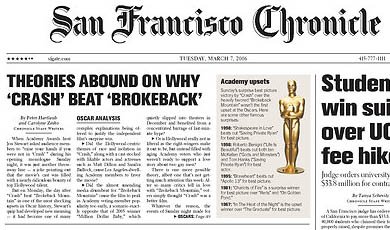
Theories around Why Crash Beat Brokeback--like I said, it was a local thing, and like I said the theme of two closeted gay men in Brokeback was too much for 'liberal', ahem, conservative Hollywood.